Join a unique initiative to combat online hate speech and innovate for democracy through tech solutions at a critical time. Organised by the Council of Europe under the New Democratic Pact for Europe and jointly with the No Hate Speech Week, this Hackathon calls on the brightest minds in tech and democracy promotion. The Hackathon is held under the auspices of the Monaco Presidency of the Committee of Ministers. Open to residents of the 46 Council of Europe member states.
• Strasbourg Awaits: All-expenses-paid trip* for selected 20 teams. Please consult the Terms and Conditions.
• Preparation and post-event implementation support by seasoned mentors (from the Technical University of Munich, the University of Strasbourg, Democracy Reporting International and the Institute of Strategic Dialogue)
• A €50,000 Microsoft grant to be shared amongst the winning teams, and post-event mentoring and implementation support will be provided.
• Council of Europe Cash Prize: an additional €15,000, bringing the total cash prize pool to €65,000!
COUNCIL OF EUROPE, STRASBOURG, FRANCE | 17-19 JUNE 2026

Join a unique initiative to combat online hate speech and innovate for democracy through tech solutions at a critical time. Organised by the Council of Europe under the New Democratic Pact for Europe and jointly with the No Hate Speech Week, this Hackathon calls on the brightest minds in tech and democracy promotion. The Hackathon is held under the auspices of the Monaco Presidency of the Committee of Ministers. Open to residents of the 46 Council of Europe member states.
• Strasbourg Awaits: All-expenses-paid trip* for selected 20 teams. *Please consult the Terms and Conditions
• Preparation and post-event implementation support by seasoned mentors (from the Technical University of Munich, the University of Strasbourg, Democracy Reporting International and the Institute of Strategic Dialogue)
• A €50,000 Microsoft grant to be shared amongst the winning teams, and post-event mentoring and implementation support will be provided.
COUNCIL OF EUROPE, STRASBOURG, FRANCE | 17-19 JUNE 2026
Hack The Hate, Renew Democracy
The Council of Europe has initiated a political and strategic consultation for a New Democratic Pact for Europe aiming at addressing the current democratic backsliding. The 17-19 June 2026 Democracy Hackathon will feed directly into this consultation process to strengthen the foundations of democracy, amplify its benefits, restore trust, and innovate its forms to make it tangible and meaningful for all.
By joining forces with the No Hate Speech Week, we are creating a unified front against the rising tide of online hostility and disinformation. Together, we are making democracy tangible by building the very tools that will defend it.
Be the best at Tech and at Democracy
Maximising Ethics, Human Rights, and Utility, the Council of Europe is calling on multidisciplinary minds to design bold, human-rights-based solutions. Your team’s project should focus on one or more of the following thematic goals:
- DATA PRIVACY: Balance the Privacy-Utility Trade-off: Build tools that effectively identify hate speech while remaining agnostic to the personal attributes of users.
- NO HATE SPEECH: Neutralise Corrosive Narratives: Detect coordinated inauthentic behaviour or targeted harassment across digital platforms.
- PREVENT MALICIOUS DOXING: Ensure that detection mechanisms cannot be weaponised to re-identify or expose anonymous online users.
- BRIDGE THE GAP TO POLICY: Create actionable insights that feed directly into the Pact’s thematic workstreams and democratic consultations.
- SOCIAL TRANSFORMATION: Solutions that transform the social dynamics of online hate by preventing, contextualising, and empowering through an intersectional lens.
- INSTITUTIONAL ACTION: Create tech-enabled referral pathways that turn raw reports into structured evidence for electoral commissions and institutional actors to effectively prioritize and escalate online violence.
Note: These goals form the foundation of our four specific Challenges. You are invited to select the challenge that best matches your team’s expertise.
How to Participate
Your Journey to Strasbourg

Form Your Trio (or Quartet)
Assemble a team of at least 3 core personas: a Designer, a Developer, and a Democracy Expert. You can add a 4th member if needed, but diversity of skills is your secret weapon. Gender balance is encouraged within teams.

Pitch Your Concept
Choose one of our 4 key topics and submit a concise concept note. We aren’t looking for finished code yet—we want to see your vision for defending democratic values through tech.

Warm Up & Fly Out
If selected, you’ll join our virtual Warm-up Session to refine your idea. Then, get your bags packed—the Council of Europe provides full travel and accommodation support* for your team to compete live at the Palais de l’Europe in Strasbourg. *Please consult the Terms and Conditions.
Democracy Hackathon Challenges

The Privacy-preserving Hate Speech Detection Challenge (PrivHSD)
Mentored by a researcher from the Technical University of Munich
- The Problem: The challenge operates at the intersection of Hate Speech Detection (HSD) and privacy protection, particularly with the ultimate goal of maximizing the “privacy-HSD” trade-off, where the optimal scenario maximizes HSD performance while minimizing loss to personal privacy protections. Using state-of-the-art techniques and metrics from both research fields, we challenge participants to innovate ways in which HSD can continue to function as urgently needed, but not at the cost of creating harmful re-identification tools. The team that can achieve the best trade-off wins!
- The Objective: Innovate a new HSD method that operates agnostically to the author’s identity. The goal is to maximise the “Privacy-HSD trade-off”— achieving high detection performance while minimising the loss of personal privacy protections.
- Potential Output: A Demonstrable Concept or working prototype accompanied by a research note articulating its rights-based architecture and privacy-preserving features. The winning team should expect to share their full results and take part in publishing their results in a scientific publication.

Coordinated Inauthentic Behaviour (CIB) Identification
Mentored by a senior fellow from the Institute for Strategic Dialogue
- The Problem: Hate-based narratives are increasingly driven by “smarter” coordinated networks rather than organic user behaviour.
- The Objective: Build a tool that detects when hate-based narratives emerge across platforms and accounts in a short window of time. LLM enabled semantic clustering can be used instead of being limited to keyword-based queries to group mentions by intention and meaning rather than simply by identical language. Participants should include at least one gendered campaign (e.g. coordinated harassment of women politicians or activists) among their test cases, as these are among the most documented forms of CIB and provide a concrete benchmark for the tool’s real-world relevance. An important threshold is determining the line between coordination and organic behavior from many authentic users.
- Potential Output: Visualized summary of narrative clusters in a dashboard designed for use by analysts or journalists. The dashboard should allow filtering by targeted identity group, including gender.

From reporting to response: Addressing online hate and gender-based violence
Mentored by a researcher of Democracy Reporting International
- The Problem: The challenge responds to a practical implementation gap during electoral periods, when harmful content is often encountered online but remains difficult for institutional actors to document, assess, and escalate. While legal frameworks and multi-stakeholder mechanisms already exist, reporting pathways are often fragmented, unevenly accessible, or not designed around gender-sensitive and electoral-risk criteria. The goal is to support timely, proportionate, and rights-respecting responses without undermining legitimate political debate or freedom of expression.
- The Objective: DRI invites teams to design a tech-enabled reporting and referral solution aimed primarily at institutional actors, including but not limited to electoral commissions, trusted flaggers, and platform integrity teams. Rather than focusing only on the reporting interface, the solution should help turn user-submitted reports of suspected online hate speech and gender-based violence (OGBV) against women candidates, as well as trans and non-binary candidates, into structured evidence that can support classification, assessment, prioritisation, and clear escalation or referral logic.
- Potential Output: Teams are expected to present a prototype/MVP, wireframe, or proof of concept that shows how reports of suspected online hate speech and OGBV would be collected, structured, classified, prioritised, and referred to relevant institutional actors. The output should include a proposed user flow, key data fields, classification criteria, and referral/escalation logic.

Think out of the box
Mentored by an academic researcher and lecturer from the University of Strasbourg
- The Problem: What if tackling hate speech was not only about removing harmful content—but about transforming the social dynamics that produce it? Hate speech online is a growing and complex societal issue, affecting social cohesion, mental health, and democratic discourse. While current solutions focus largely on detection and content removal, they often fail to capture context, add ress bias, or empower users. This challenge invites participants to think out of the box and go beyond traditional moderation approaches. Rather than focusing solely on detection, teams are encouraged to explore new ways to prevent, contextualize, counter, and transform hate speech in digital environments.
- The Objective: Design a solution that prevents, contextualises, counters, or transforms hate speech rather than simply moderating it. Teams are encouraged to combine technology, design, policy, and creative approaches, targeting any relevant group from social media users and platform moderators to educators, NGOs, or policymakers. An intersectional approach to the work, including gender, age, origin and/or other grounds of discrimination is encouraged.
- Potential Output: A functional prototype or MVP in any form (web or mobile application, moderation support interface, educational experience, policy framework, or creative concept with social impact), accompanied by a 5-minute pitch and a short concept paper outlining design choices, methodology, and ethical considerations.
Ideal team
We are seeking multidisciplinary teams of 3 to 4 members to move beyond a simple technical tool and create a Human-Rights Centred Innovation. Here is how they work together.

The Technologist / Back-end Developer
Determines which AI capabilities (like semantic clustering or LLM-enabled identification) can address the problem without creating harmful re-identification tools.

The Democracy / Policy Expert
Help identify needs and identify innovative methodologies and policy solutions to address the challenge in line with human rights and democratic principles.

The Designer / Idea Innovator
UX/UI Front-end developer will translate complex data into “actionable insights” for end-users and demonstrate the “Impactful Initiative” through a working prototype that judges and the audience can visualise and comprehend.

Concept Summary Submission
The First Step to participate
To be considered for the New Democratic Pact for Europe Democracy Hackathon, pre-formed teams must submit a Concept Summary (2 pages maximum). Your Summary must include:
- Problem & Solution Fit: A clear description of how your solution addresses the hate speech while balancing technical effectiveness with human rights (such as privacy, freedom of expression, and institutional transparency).
- Integrated Innovation: An overview of the technical engine (AI/NLP), the human rights guardrails (Policy/Law), and the user experience (UX/UI).
- Impact: how your solution translates the principles of the New Democratic Pact into a tool that helps real people and protects democratic debate.
The registrations are officially closed. The photos are now available to view.
Frequently Asked Questions
Do I need to know how to code to be part of a Hackathon team?
No. Multidisciplinary teams are essential. Democracy, journalism, arts, strategy, and policy all have a place here.
How do I apply?
Teams should submit a short registration form with the 2-page concept document, directly on this page, not individuals. Apply before 5 June 2026!
Where is the event going to take place?
The event will take place in the headquarters of the Council of Europe in Strasbourg, France!
Do I have to pay for this event?
No, the event is free of charge for the teams selected for participation in this Hackathon. In addition to that, all essential expenses related to their participation (travel, accommodation, meals) are covered by the Council of Europe*. Please consult the Terms and Conditions.
Should I bring my laptop?
You must bring your own laptops and any tools you think can be useful! The Council of Europe will provide you with office supplies to support your project development.
What kind of support will mentors provide during the Hackathon?
Mentors will be available throughout the event to guide teams on strategy, ethics, and technical aspects. They will help refine ideas, give feedback, and ensure your project aligns with the challenge goals.
What is the duration of the Hackathon?
The Hackathon includes four online warm-up sessions (one per challenge) in the weeks leading up to the event, followed by a 2.5-day final in-person event in Strasbourg on 17-19 June 2026 (including participation in sessions of the Council of Europe No Hate Speech Week, which will be held parallel to the Hackathon). Implementation support will be provided to winning teams after the Hackathon.
What are the prizes for the winning teams?
A total prize of €50,000 will be distributed amongst winning teams, and post-event implementation support will be provided by the Council of Europe. Terms and conditions may apply to your specific country of residence.
Learn more on the New Democratic Pact for Europe website
Follow our day-to-day action
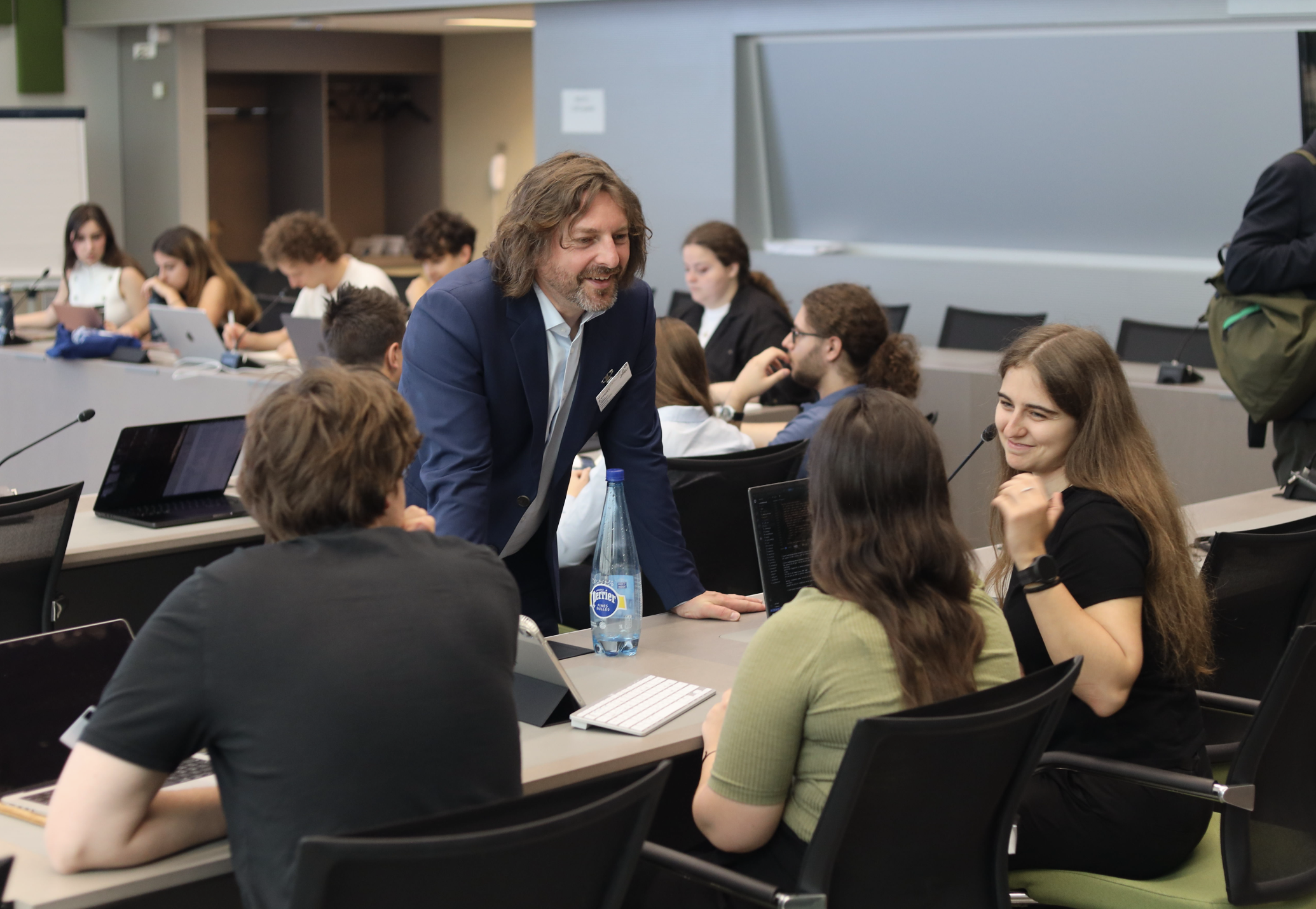
A Vibrant Kick-off
17 June 2026
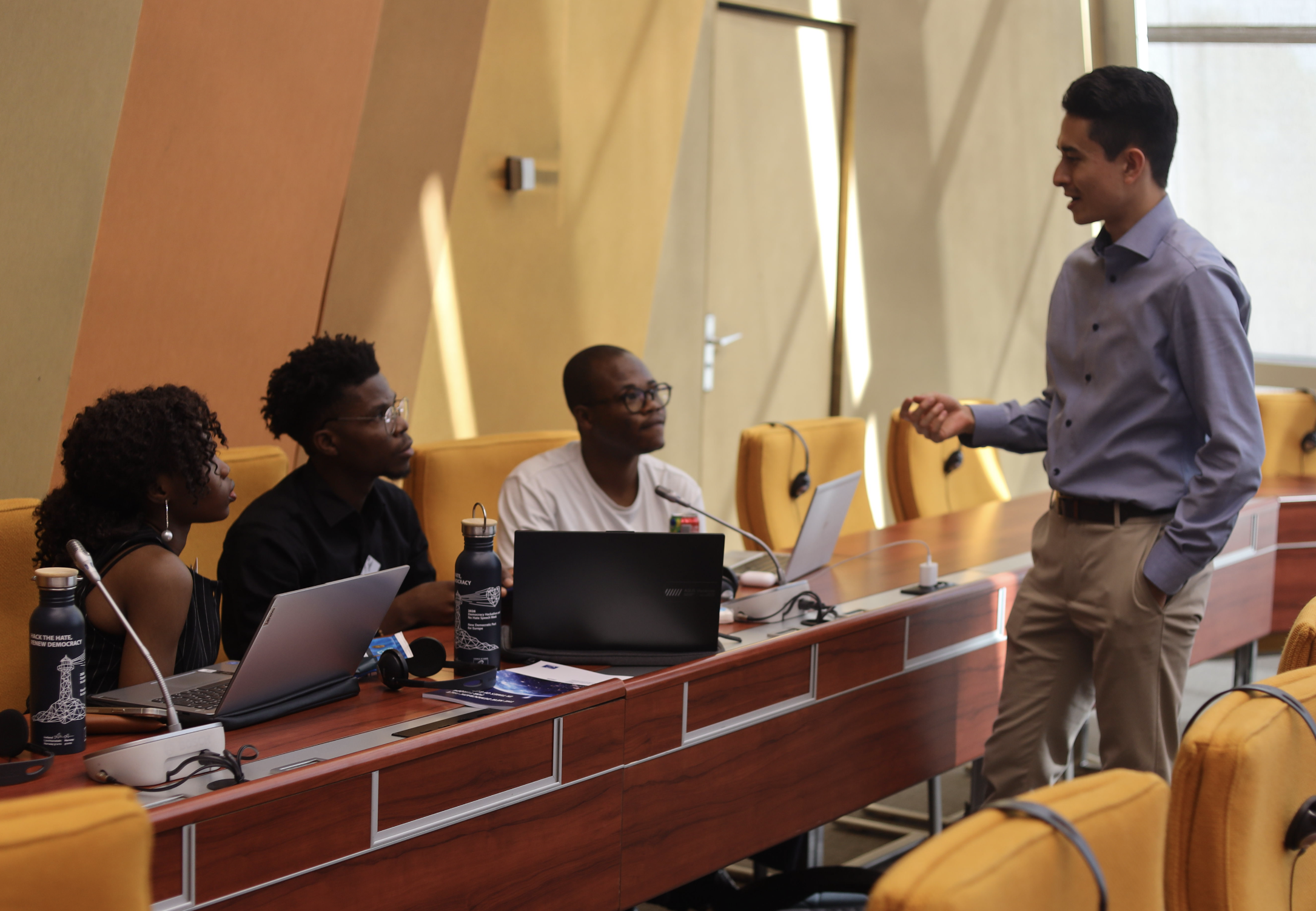
Deep Collaboration to NHSW
18 June 2026

And the Democracy Hackathon winner is!
19 June 2026
Warm-up Online Sessions
The Privacy-Preserving Hate Speech Detection Challenge (PrivHSD)
Stephen Meisenbacher from the Technical University of Munich
11 June @ 16:00 CET
Coordinated Inauthentic Behaviour (CIB) Identification
Zahed Amanullah from the Institute for Strategic Dialogue (ISD)
12 June @ 16:00 CET
From reporting to response: Addressing online hate and gender-based violence
Camila Weinmann, researcher of Democracy Reporting International
13 June @ 16:00 CET
Think Out
of the Box
Prof. Dr Sabine Cullmann from the University of Strasbourg
16 June @ 16:00 CET
Get ready for the Hackathon in June!
- Date: 17–19 June 2026
- Location: Palais de l'Europe, Strasbourg, France
- Costs: Travel and accommodation covered for all selected teams
- Eligibility: Open to residents of any of the 46 Council of Europe member states
- Language: English
- A €50,000 Microsoft grant to be shared amongst the winning teams, and post-event mentoring and implementation support will be provided.
Come to the heart of Europe and build the tools that will protect democracy!

Organized by
Powered by

The Hackathon is organised by the Council of Europe. All rights reserved.